ServicesWater testing
Water Testing in Garland
Before anyone sells you a filter, you should know what is actually coming out of your taps. We test the water inside your home, look at the plumbing it travels through, and explain the results in plain terms. Sometimes the right answer is no equipment at all.
What a water test tells you, and when it is worth doing
The city treats your water and reports on it, but that report describes water leaving the treatment plant. It cannot tell you what happens over the last stretch, through your service line, the pipes in your walls, an old water heater and the fixtures at the sink. That last stretch is where most of the questions we hear begin.
Older houses make this more important. A home built before the late 1980s may still have lead-based solder on copper joints, sections of galvanized steel pipe, or brass fixtures that predate today's low-lead rules. Many have also had repairs over the years that mixed copper, galvanized and plastic in the same run. Each of those can change taste, color or what ends up in a glass.
We test first because it keeps the conversation honest. If your water reads well, we tell you so. If something shows up, we can point to the number and match it to the right fix, whether that is whole-house carbon filtration, an under-sink reverse osmosis system or simply a plumbing repair.
What our water testing includes
On-site readings at your taps
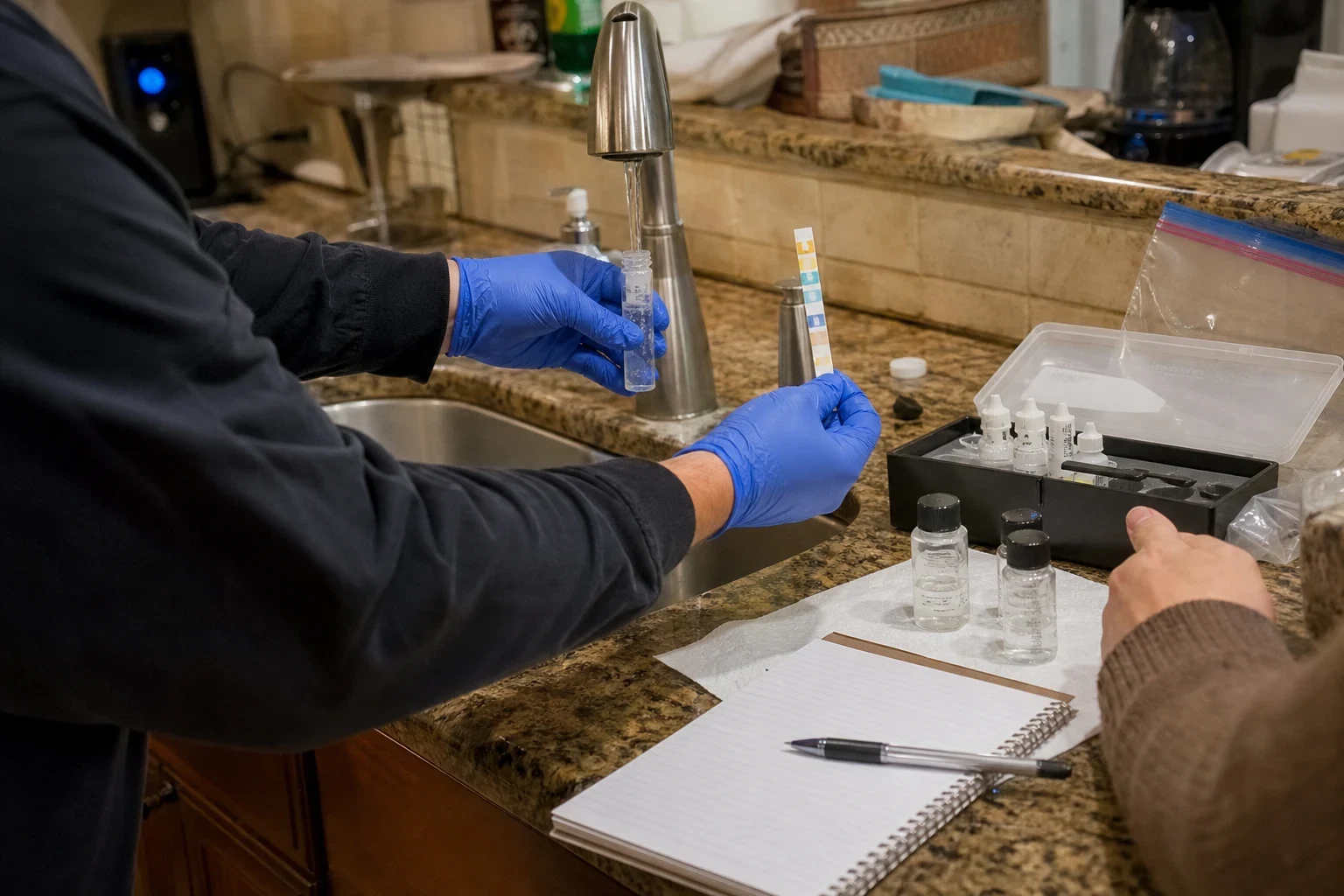
We check hardness, iron, pH, total dissolved solids and chlorine at the kitchen sink and at least one other fixture. Readings from two points help show whether an issue is in the supply or in one part of the house.
A look at the plumbing
We note what your pipes are made of where they are visible, at the water heater, under sinks and at the main shutoff. Galvanized sections, old solder and patched repairs all shape what we test for next.
Lab testing when it matters
Lead and some other contaminants cannot be measured reliably with a field kit. When your home's age or plumbing points that way, we collect a sample and send it to an independent lab.
A written summary
You get the results written down with what each number means, what is normal and what, if anything, deserves attention. Nothing is buried in jargon.
A straight recommendation
If treatment makes sense, we explain which kind and why. If it does not, we say that too, and you are under no pressure to buy anything.
Signs your water is worth testing
Your home predates 1986
Lead solder was common on copper plumbing until federal rules changed in the mid-1980s. A test is the only way to know whether it is reaching your tap.
Rust tint or orange stains
Brown water after a few days away, or orange rings in tubs and toilets, often point to corroding galvanized pipe or iron in the water. Testing tells you which, and whether iron and sediment filtration would help.
A chlorine or swimming pool smell
Treated city water carries a disinfectant, and some people notice it strongly. Measuring it helps decide whether carbon filtration is a good fit.
White crust on fixtures
Scale on faucet aerators and shower heads suggests some hardness. A hardness reading tells us whether a softener is justified or whether descaling now and then is enough.
Recent plumbing work or a new baby
After a repipe, a water heater swap or with an infant in the house, many families simply want a clear baseline. That is a perfectly good reason to test.
How a testing visit runs
- 1
A short conversation by phone
We ask about your home's age, any past plumbing work and what you have noticed. That lets us bring the right kits and know whether lab samples are likely.
- 2
Readings and a plumbing walk-through
At your home we draw samples from the taps we agreed on, run the on-site tests and look at visible pipes and the water heater. We wear shoe covers and leave each area as we found it.
- 3
Lab samples, if needed
For lead or anything a field test cannot confirm, we take first-draw and flushed samples so the lab can tell plumbing sources from the supply. Results come back after the lab finishes its work, and we go over them with you.
- 4
Results and next steps
We walk you through the numbers, answer questions and, only if the results call for it, outline treatment options with a written estimate.
What affects the cost of water testing
A basic set of on-site readings is the simplest visit. The price rises mainly when the house or the question calls for lab work. We tell you what a test will involve and cost before we take a sample.
- Field readings or lab analysis
- On-site tests cover the everyday questions. Independent lab panels for lead or other contaminants add cost because each sample is analyzed separately.
- Number of sample points
- Testing one kitchen tap is quicker than comparing several fixtures, a well-used bathroom and the water heater outlet.
- Age and makeup of the plumbing
- Mixed materials from past repairs often justify extra samples so we can trace where a problem starts.
- Follow-up testing
- After a repair or a new filter, a second round confirms the change worked. Some homeowners also like a yearly check.
Water testing questions
Something not covered here? (972) 646-8233
Isn't city water already tested?
Yes, and the utility's testing covers water as it leaves treatment and moves through the mains. It does not cover the pipes and fixtures inside your home. In an older house, that inside plumbing is usually what changes the water most.
Will you try to sell me a filter afterward?
Only if the results point to one. Plenty of tests come back showing water that is fine as it is, and we tell you so. When something does show up, we explain the options and leave the decision with you.
Can you test for lead?
Yes. Because field kits are not reliable for lead, we collect samples and send them to an independent lab. Taking a sample after the water has sat overnight and another after flushing helps show whether lead is coming from your fixtures and solder.
Do I need to be home for the test?
Yes, an adult should be there so we can reach the taps, the water heater and the main shutoff. It also gives you a chance to ask questions while we work. Please avoid running water heavily for a few hours beforehand if we are taking first-draw samples.
Do you serve areas outside Garland?
We test homes in Garland and nearby communities including Rowlett, Sachse, Richardson and Mesquite. Our Service Areas page lists the rest.
Know what is in your water before you choose anything
A test gives you real numbers to decide with, and in an older home it often explains problems you have lived with for years. Tell us about your house and we will plan the right test.